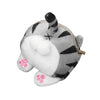
Cats can see mostly blues, violets, and some greens and yellows, because they have two types of color-detecting cones in their eyes while humans have three. Reds, pinks, and oranges look muted, usually as grayish or brownish tones. If you have ever wondered what colors can cats see, this guide explains how cat vision works and how to choose toys your cat will actually notice. Table of Contents What colors can cats see? Are cats colorblind? How do cats see at night? What toy colors work best for cats? How Petzeals can help your cat play Frequently Asked Questions Conclusion What colors can cats see? Cats see the world mainly in shades of blue, violet, and yellowish or greenish tones. Their retinas contain two kinds of cone cells, one tuned to blue-violet light and one tuned to green-yellow light. Humans have a third cone type, which lets us separate reds, oranges, and greens clearly. In practice, a bright blue toy will look vivid to your cat. A yellow toy will probably stand out too, though it may look more like a pale tone than the warm yellow you see. Green can be visible, but it often blends into a yellowish gray. Red and pink are the trickiest. A red ball on a green lawn may look like a dull brownish shape on a similar-colored background. Your cat can still find it, but not because of color. Cats rely heavily on movement, brightness, and contrast. Here is a simple way to picture it. Imagine the world with the red end of the rainbow turned down. Blues stay lively, while warm colors fade and become less distinct. Cats also see fine detail less sharply than people do, so the world looks a bit softer to them, especially at a distance. The Cat page on Wikipedia notes that cats are well adapted to hunting in low light, which helps explain why their eyes favor motion and brightness over rich color. Are cats colorblind? Not completely. Cats are often compared to people with red-green color blindness, but that comparison is only a rough guide. They do see color, just a smaller range of it than we do. The key difference is the number of cone types. With two instead of three, a cat cannot separate colors that depend on the red part of the spectrum. Many reds, oranges, and greens may look alike to them. Cats also have fewer cones overall than people. Their eyes contain far more rod cells, which handle dim light and motion. This trade-off makes color less detailed, but it gives cats a big advantage at dusk and dawn, when they are most active. So your cat is not living in a black-and-white movie. It lives in a softer, bluer, less saturated version of your world. That is why a cat may ignore a toy that looks bright red to you but go wild for one that moves in an unpredictable way. How do cats see at night? Cats are famous for their night vision, and the reasons are well understood. Here are five features that help them see in dim light: Many rod cells: Rods detect low light and movement, giving cats an edge when the room is dark. Large corneas and pupils: Cat pupils can open wide to let in more light. A reflective layer: Behind the retina sits a layer that bounces light back through it, which is why cat eyes seem to glow in headlights. Slit-shaped pupils: These can narrow quickly in bright light and open wide in the dark. Sensitive whiskers: Whiskers help your cat sense nearby objects when vision is limited. Cats do not see in total darkness, though. They simply need far less light than we do. If your cat seems to bump into things or has cloudy eyes, a sudden change in vision is worth a visit to your veterinarian. What toy colors work best for cats? Because cats see blues and yellows best, toys in those colors are a smart pick. A blue feather wand or a yellow ball is easier for your cat to pick out than a red one on a green rug. Still, color is only part of the story. Cats are predators, so they respond strongly to motion. A toy that skitters, darts, or changes direction grabs attention even if its color looks dull to your cat. Contrast matters too. A light toy on a dark floor, or the other way around, is easier to track than a toy that matches your carpet. Texture and sound add to the fun, so crinkly or rustling materials can keep your cat interested. If your cat has a favorite red toy, there is no need to throw it out. It may be the movement, scent, or feel your cat loves. Rotating toys every few days also keeps playtime fresh and prevents boredom. How Petzeals can help your cat play Now that you know how your cat sees, you can shop smarter. Look for toys that combine visible colors with lively movement, since motion is what truly triggers a cat's hunting instinct. Our cat toys collection includes options built around this idea. For a cat that loves to chase, a moving toy mouse for interactive hunting play is a great place to start. Its darting motion is easy for your cat to notice, even when colors look muted. It is especially handy on days when you cannot join in with a wand. Always supervise play with new toys, and put away any pieces that become loose or damaged. If your cat suddenly loses interest in play or seems to struggle to see, ask your veterinarian to check its eyes. Frequently Asked Questions Can cats see red? Cats do not see red the way people do. Red usually appears as a dark, muted tone, often gray or brownish. A red toy can still attract your cat through movement, shape, and scent, so it is not useless. Do cats see in black and white? No. Cats see some color, mainly blues and yellowish-greens. Their color range is narrower than ours, and shades look less vivid, but the idea that cats see only black and white is a myth. Can cats see better than humans? It depends. Cats see better in dim light and are very good at noticing motion. Humans see more colors and sharper detail, especially far away. Each is well suited to its own lifestyle. What color of toy is best for a cat? Blue and yellow toys are usually the easiest for cats to see. Pair them with movement and a background that contrasts with the toy. Many cats also love toys because of texture and sound, not only color. Do cats see TV screens? Some cats seem to watch moving images, especially birds or fish. Cats notice motion well, so lively shapes can catch their eye. Colors may look different to them, but movement is often what holds their interest. Conclusion Cats see mainly blues, violets, and yellowish-greens, while reds and pinks look dull and grayish. Their eyes favor motion and low light over rich color. Choose bright blue or yellow toys that move, and browse the Petzeals toys collection to find playtime favorites your cat can truly see.